While we didn't make it to Gaza
With One Voice, the Whole World Stood With Palestine
In September 2025, 42 boats and 462 people sailed across the Mediterranean in a civilian, nonviolent mission to break Israel's illegal siege on Gaza and stand with the Palestinian people.
Coordinated mobilizations across dozens of countries turned ports, plazas and city streets into a single chorus for life, humanity and liberation. Ordinary people proved that you don't need permission to stand on the side of dignity, and that when governments fail, people have a duty to rise up.
Barcelona Launch
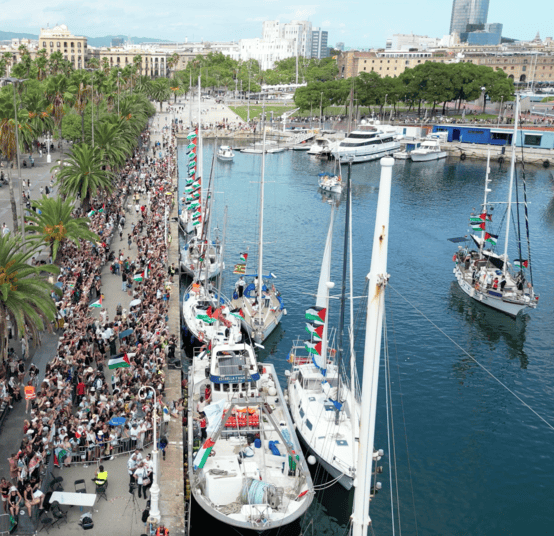
On August 31, 2025, thousands gathered at the Port of Barcelona to witness the launch of around 20 boats of the Global Sumud Flotilla. With participants from more than 40 countries—including doctors, artists, seafarers and human rights defenders—the flotilla set sail in a powerful act of nonviolent resistance and solidarity with the Palestinian people.
During the press conference, speakers condemned international silence and complicity, calling the mission not an act of charity but of justice, and describing "Sumud," Arabic for steadfastness, as the spirit uniting them. Despite strong winds delaying some departures, the launch ignited a wave of global attention and public mobilization, as chants for Palestinian freedom echoed through Barcelona's waterfront. The city, with its deep history of civil resistance and symbolism as a hub of people power, marked the beginning of a journey that would help capture the conscience of the world.
Tunisia Arrival
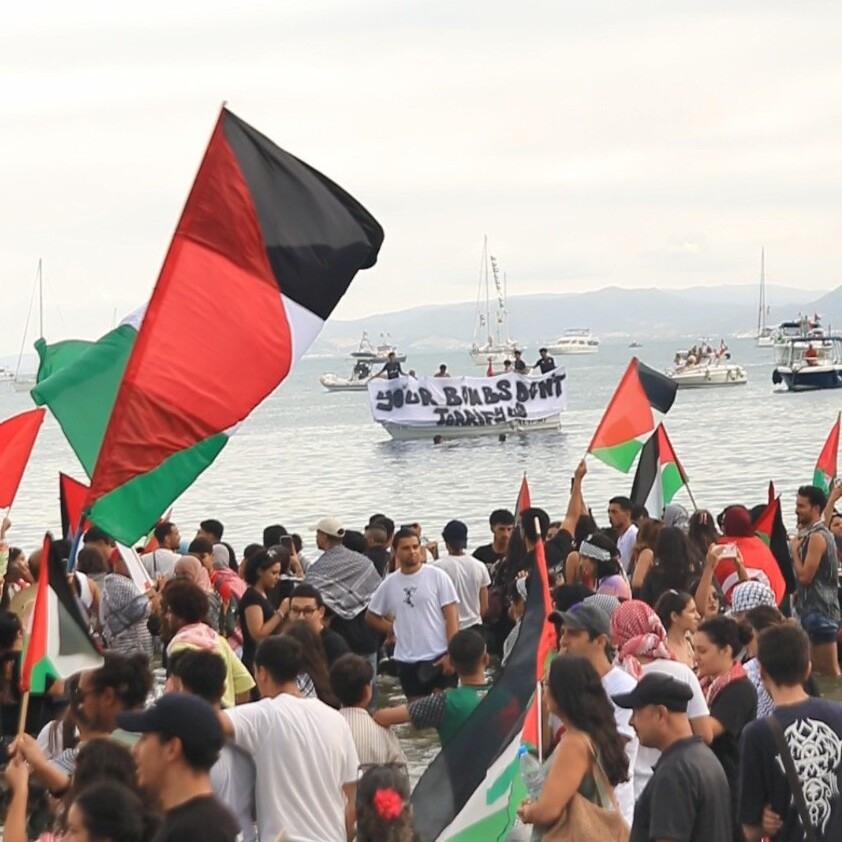
On September 7, the Global Sumud Flotilla boats from Barcelona arrived along the Tunisian coast, where crowds gathered in Sidi Bou Said to welcome the boats with cheers, music, and Palestinian flags waving in the sea breeze. Volunteers, civil society groups, and local authorities helped coordinate supplies, logistics, and safety checks as vessels from Spain. The atmosphere was electric and deeply emotional—Tunisia, long a symbol of regional solidarity and resistance, opened its ports and its people's hearts to the mission.
Press conferences and public events highlighted the unity of the global coalition and the importance of North Africa's role in breaking the siege. For many, Tunisia represented more than a waypoint—it was a living bridge between continents, proof that the spirit of sumud had transcended borders.
The Attacks on Family & Alma
On September 8th and 9th, while anchored off the port of Sidi Bou Said, Tunisia, our two lead boats—Family and Alma—were struck by what CCTV footage and eyewitness accounts indicated was a drone-launched incendiary device, igniting a fire onboard. All crew members survived, but the incident sent shockwaves through the mission and highlighted the escalating risks faced by civilian vessels attempting to reach Gaza.
Weeks later CBS News reported, citing unnamed U.S. intelligence sources, that a classified briefing alleged the drones were launched from submarines and linked to high-level Israeli authorization.
Leaving Tunisia
Departing Tunisia proved to be one of the most challenging stages of the Global Sumud Flotilla's journey. After days of coordination, repairs and regulatory hurdles, the fleet finally set sail in mid-September, leaving from multiple ports—including Bizerte and Sidi Bou Said—to begin the next leg toward Gaza. Each departure required navigating complex logistical, legal, and security constraints, with crews working around the clock to ensure every vessel was seaworthy and accounted for. As the boats pulled away from Tunisian shores, they were seen off by supporters waving flags and singing songs of solidarity. Despite delays, the mission continued, and participants remained determined to reach Gaza and keep the focus on Palestine.
Life Support Joins
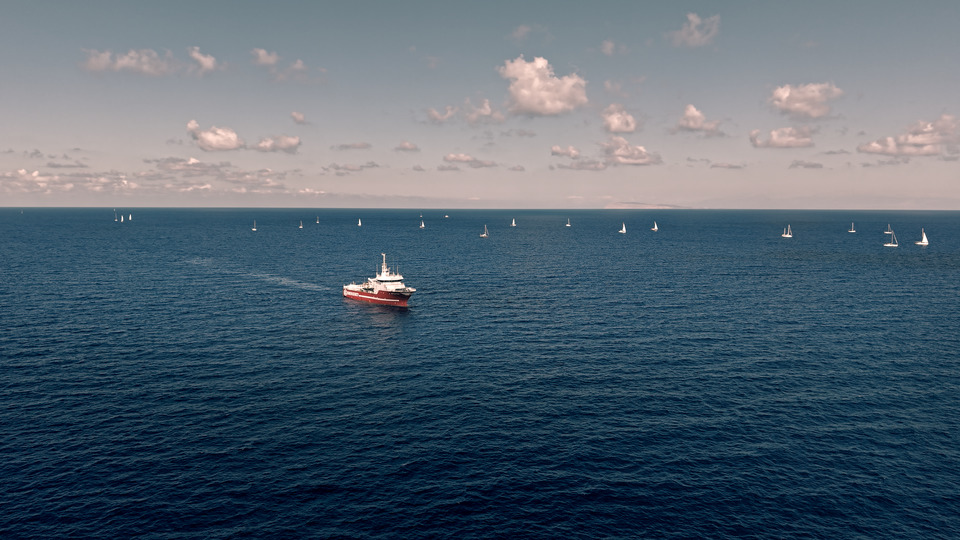
As the fleet neared the Sicilian coast, the humanitarian rescue vessel Life Support, operated by the Italian NGO EMERGENCY, joined GSF, reinforcing the mission's medical and rescue capacity as it advanced toward Gaza. For years, Life Support had patrolled these same waters, saving migrants and refugees escaping war, poverty and persecution—lives shaped by the same global injustices that fuel the siege on Palestine. Its presence symbolized a profound link between struggles: those displaced by the violence of borders and those imprisoned behind them. As the ship joined the fleet, it carried expertise, support and moral weight, reminding the world that the fight for freedom, dignity and the right to life knows no sea, and no separation between peoples.
The Italian Fleet Launch
In early September 2025, Italy launched its fleet of 17 ships as part of the Global Sumud Flotilla, with boats departing from ports including Palermo, Catania and Naples. Activists, seafarers and humanitarian volunteers gathered along the docks waving Palestinian and Italian flags as the ships prepared to sail. The launch was accompanied by press conferences, musical performances, and emotional speeches highlighting Italy's deep history of popular solidarity with the Palestinian struggle. Local dockworkers and port authorities assisted in final preparations, while civil society organizations coordinated supplies and safety checks. Despite unpredictable weather and growing international scrutiny, the Italian fleet set out with determination—its departure symbolizing the unity of everyday people standing together against injustice, to challenge siege and silence alike.
On September 19, the Italian GSF fleet joined the fleets from Barcelona and Tunis to, finally and despite delays, sail together toward Gaza.
The Greek Fleet Launch
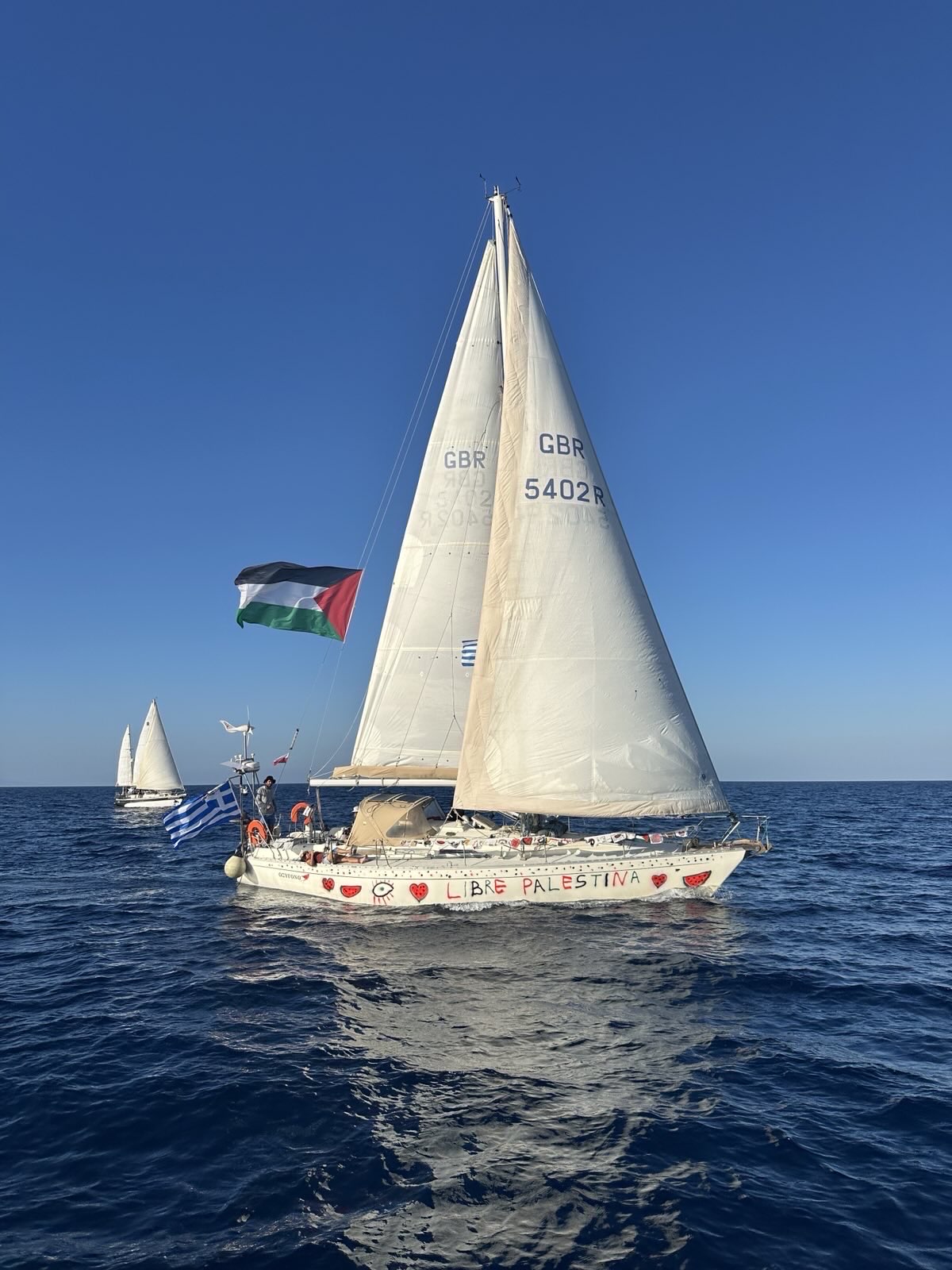
On September 22, 2025, the Global Sumud Flotilla's Greek fleet set sail from Crete and other nearby ports, joining vessels from Italy, Tunisia, and Spain already en route toward Gaza. Greek activists, long at the forefront of solidarity flotillas, worked alongside international crews to finalize inspections, refuel ships, and navigate last-minute weather and legal clearances. Despite mounting pressure and surveillance in nearby waters, the atmosphere remained determined and defiant.
As the boats departed under the early light, chants of "Free Palestine" echoed across the docks, and the flotilla, now nearly complete, pushed onward toward its final stretch across the eastern Mediterranean—bound for Gaza and for freedom.
Drone Attack Off the Coast of Greece
A week later, as the fleet entered the Greek Search and Rescue (SAR) zone, activists reported over 15 drones targeting twelve vessels—loud bangs, dropped devices and communication blackouts were documented. "From the bridge, we saw a large number of drones approaching from different directions," said one participant, "and flashes of explosions hitting several boats."
No state has claimed responsibility. These incidents occurred in international waters and within civilian maritime zones, raising urgent questions about freedom of navigation, aerial warfare accountability and the safety of humanitarian missions.
Despite the threats, the flotilla held its course. Every drone, every disruption, only strengthened our resolve.
Naval Vessels Dispatched
Both Italy and Spain dispatched naval vessels into the Mediterranean after the drone attacks on the Global Sumud Flotilla, a move framed as a gesture of humanitarian concern. Italy redirected the frigate Virginio Fasan (F 591), already operating north of Crete, to provide maritime support to the civilian fleet, while Spain deployed the patrol vessel Furor (P-46), stating that its mission was to protect the rights of Spanish citizens and other participants to navigate safely. Though both governments emphasized their intentions as protective and non-confrontational, the deployment revealed the limits of Europe's political will.
These ships—capable of carrying the entirety of the flotilla's humanitarian aid—were sent not to break the blockade, but to symbolically observe it. And just as the flotilla approached the so-called "orange zone," still within international waters, the naval escorts withdrew. Their departure underscored a troubling truth: that European governments possess both the power and the capacity to end Israel's illegal siege, yet choose instead to offer gestures of protection without the courage of intervention.
Illegal Interception at Sea
Starting on the night of October 1, our humanitarian mission was illegally intercepted by Israeli occupation naval forces while in international waters, starting around 120 nautical miles from the coast of Gaza.
As the civilian vessels advanced peacefully, they were threatened over the radio, their communications were jammed, and live broadcasts abruptly cut. Warships surrounded the flotilla and began their assault, using high-pressure water cannons and unidentified liquid substances.
Several boats were hit, their decks flooded and crews thrown off balance as soldiers shouted orders through loudspeakers before boarding at gunpoint. By midnight, at least a dozen boats had been seized, and by dawn, most vessels had been forcibly taken. These attacks—carried out in defiance of international maritime law and in international waters—underscored the extreme measures taken to prevent humanitarian aid and solidarity from reaching Gaza, revealing once again the lengths to which the Israeli occupation government will go to enforce its illegal siege.
Illegal Kidnapping and Detention
After the interceptions, hundreds of Global Sumud Flotilla participants were taken to Ashdod and later to detention facilities such as Ktzi'ot, where Adalah—The Legal Center for Arab Minority Rights in Israel—documented widespread due-process violations. Immigration and detention hearings were initiated without notice to defense counsel and often held without lawyers present. Many participants were denied legal access for days, held incommunicado, and reported degrading treatment, rough handling, and unsanitary conditions.
Adalah attorneys described systemic obstruction to legal representation and basic rights throughout the detention period—clear violations of both Israeli and international law. Yet even these abuses, inflicted on foreign civilians under global scrutiny, pale in comparison to the daily reality faced by Palestinians enduring indefinite detention, torture, and collective punishment under Israel's apartheid regime. The flotilla's ordeal offered the world a brief glimpse into the machinery of oppression Palestinians confront every day, hidden behind the walls of torture facilities and blockades of Gaza.
The People Rose Up
When Israeli naval forces illegally intercepted and kidnapped 462 civilians in international waters, the world erupted. From New York to São Paulo, Dublin to Barcelona, people poured into the streets demanding accountability and freedom for Palestine.
Each mobilization was part of the same heartbeat of resistance. Together, they formed a global wave that broke through censorship and political cowardice, reminding the world that humanity cannot be blockaded and that when governments fail, people will rise up.
Our boats were seized, but our message sailed on. Across continents, people rose not only to demand the release of those detained, but to call for an end to the siege itself. What began as a maritime mission became a worldwide awakening—proof that even when our ships are captured, sumud, steadfastness, cannot be sunk.
Show Your Support
This mission belongs to the people and its success depends on your support. We urgently need your contributions to fund the logistics of this 100-boat fleet, stock life-saving medical equipment, and sustain our crews on the water. Whatever you can donate, be that funds or materials, will ensure the mission's viability.
Remember to stay tuned to our social media channels, and sign up for our newsletter below to receive the latest updates as they happen. By sharing this website and our content, including links to the donation page, you will be doing your part to amplify the movement and provide critical support to the people of Palestine.